

How Much Do Treks Cost?
Yes, we’re going to explain all the ins and outs of how much do treks cost. Long Himalayan treks are not cheap, and you should understand where your hard-earned money is going… plus the travel industry isn’t very transparent, so this will help you understand what’s going on behind the scenes during your dream holiday!
We don’t have the space to go into every detail for each trek in Nepal, India and Bhutan – so we’re going to explain costs for the GHT Nepal High Route 120-day trek and you’ll learn all you need to know to ask the right questions in India and Bhutan. Also, we’re going to compare costs for Solo, Couple Trekkers and Fully Supported Treks.
We’ve already looked at Flight and Travel Tips and because you could be travelling from anywhere, we’re going to ignore your flight and travel insurance costs from the trek budget.
To calculate How Much do Treks Costs, we use the following structure:
- Permits and Entry Fees
- Support Staff
- Meals and Fuel
- Transportation
- Administration & Contingencies
- Flexibility, Changes, Tips and Surprises
- Putting it all together.

The money you spend while trekking can have an amazing positive impact for locals. But there are other impacts too, to understand them, see The Impact of Your Trek.
1. Permits and Entry Fees
These include all your ‘trekking permits’, which in Nepal, are Protected Area Entry Fees (National Parks, etc) and Restricted Area Permits (special areas).
- Protected Area Entry Fees – National Parks, Conservation Areas, Hunting Reserves, etc; and,
- Restricted Area Permits – areas determined to be ‘sensitive’, normally close to areas not covered by protected area status, but both is possible!
In Nepal’s Restricted Areas, you must have a registered guide and issue 2 foreigner permits. If you want to trek on your own, this means paying for 2 permits (one for an imaginary friend).
In Bhutan, all your permits and fees are included in the US$250 daily rate (see more below).
Whereas, in India they vary depending on the location and getting accurate current information is impossible. Ask trekking agencies about prices but they could still be different on the day. However, costs normally work out to be similar or a bit less compared to similar distances in Nepal (see more below).
The information for the following costs is from the Government of Nepal, Department of Immigration and Nepal Tourism Board. For more info see Visas and Permits. The most common fees for Nepal are outlined below and some examples for costs associated with popular routes.
Popular GHT Nepal regions and what permit(s) you need:
- Kanchenjunga – Restricted Area Permit and KCA Entry Fee.
- Makalu – MNP Entry Fee and possibly Sankhuwasabha Permit.
- Solu-Khumbu (Everest) – SNP Entry Fee.
- Rolwaling – GCA Entry Fee and possibly Dolakha Permit.
- Langtang – LNP Entry Fee and possibly Rasuwa Restricted Area Permit.
- Ganesh Himal – none.
- Manaslu – Restricted Area Permit and MCA Entry Fee and possibly Tsum Permit.
- Annapurna – ACA Entry Fee and possibly Naar-Phu Restricted Area Permit.
- Upper Mustang – Restricted Area Permit and ACA Entry Fee.
- Lower Dolpo – Restricted Area Permit.
- Upper Dolpo – Restricted Area Permit and SPNP Entry Fee.
- Far West Nepal – Mugu, Humla, Bajhang and Darchula Restricted Area Permits, and RNP Entry Fee.


Your Route Plan, Permits and In-Field Costs are All Linked.
OK, so you’ve booked a flight, bought travel insurance and calculated your permits and fees for your chosen route. You should also include an amount for taxis, accommodation and meals in Kathmandu and/or Pokhara. These costs are entirely up to you and we’re not going to include it here – check out sustainable hotel ideas on www.bookdifferent.com.
Now you have a serious and very important question to answer – how will you arrange and pay for goods and services along the trail? – and this is the most important part of calculating how much do treks cost.
How Much Does a Trek Cost Will Depend on the Region/Route – You must have a guide with you in Restricted Areas, even if you are on your own (which means you’ve paid for 2 Permits). Places where you can trek on your own – see table to the right.

Your Trekking Style will Dictate How Much Your Trek Costs
Over the years we’ve found that folks fall into three generalised trekking styles:
- Solo Independent Trekkers like to organise their own plans, which includes permits, tickets, negotiating with locals if they want a guide, choosing where to stay and what to eat.
- Budget Focused Individuals or Small Independent Groups (1-4 people) who find a local trekking agency in Kathmandu or Pokhara and then negotiate a price for essential guiding, camping crew and services.
- Convenience Focused Individuals or Small Groups (1-4 people) who are happy to combine with others and want the convenience and simplicity of booking through an international or local adventure tourism business for a fully serviced trek.
For more information see Which Style of Trek is right for you?
Use the Right Style at the Right Time
To make things a bit more complicated, it is possible to take different approaches in different regions – for example, in Kanchenjunga trek with a guide who leaves you in Olangchungola to bring re-supplies to you in Makalu Base Camp. They then leave again from Dingboche, to bring re-supplies in the Manaslu region… get the idea? This approach means that you have to be very good at mountain navigation and speak some Nepali, but it reduces costs and solves re-supply issues.
Important questions to answer when deciding which approach suits you:
- Are you prepared / have the time to do the running around and negotiating yourself?
- Or do you prefer to use local trekking company and deal with potential communication issues?
- Or do you want the easiest and most convenient option and book through a company in your country?
Answers to these questions involve clear advantages and disadvantages. The more you do yourself and the more local you go, the greater the authenticity and cheaper the cost… but, the less guarantees you have in quality, safety, security and convenience.
If you are confused or want to discuss options in different regions then please Get in Touch… we’re happy to help!
2. Support Staff
Most GHTers only want to have a guide when it’s obligatory. However, some folks want to have a support team with them for the whole trail, which we call a Fully Supported Trek. There is a big cost difference between having a guide with you sometimes and a crew of 5 or 6 with you all the time. However, a Fully Supported Trek has a few major benefits:
- You don’t have to carry much weight,
- You don’t have to worry about navigation, campsites, cooking, etc; and,
- The extra money you spend is in remote villages and local wages, which has very positive social impacts – see The Impact of Your Trek for more info.
Typical daily costs (including food and accommodation) for staff in Nepal are: Trekking guide in Nepal – US$55, Technical climbing guide – US$75, Remote area cook – US$35, Remote area porters US$25

Trekking with your crew will feel like meeting new family – lifetime friendships are easily made in the Himalaya!
3. Food and Fuel
You and any crew that are with you have to eat and sometimes buy fuel when in remote areas. Food and fuel costs vary enormously along the GHT, where a cup of tea can cost 50cents to US$4! So, we calculate an average daily cost of US$35 per trekker based on previous season costs – but this is if you only eat the local food (dhal bhat and packet noodles are the most common) and do not eat western dishes, which are much more expensive.
Eating local meals is a really good idea as you will be served much more food (dhal bhat is refillable at no extra cost), and it’s super fresh and healthy. And let’s face it, why would you come trekking to eat bad pasta anyway?

Dhal Bhat is Nepal’s national dish: rice (bhat), lentils (dhal), veggies and/or meat curry, pickles and sometimes a little salad and curd.
4. Transportation
Transport costs can be exaggerated for foreigners. There are two types of transport costs, those to get you to and from the trail and those for your support team to get to and from the trail. We recommend purchasing domestic flights through a local travel or trekking agent as timings often change and passenger communication is basic. It’s worth noting that domestic airfares in the Himalaya are expensive when compared to international prices. In fact, Nepal is one of the most expensive places for domestic flights in the world. There is ‘talk’ of making locals and foreigners pay the same price for a ticket, but that might take years to happen – at the moment foreigners pay about double the local price. In Nepal, foreigners pay approximately double the local price for transport, except for local buses that charge the same for all passengers. Domestic flights in Nepal are expensive and can be unreliable. Example transport costs:
- Foreigner flight to Lukla (one way) – US$165
- Foreigner flight Kathmandu – Nepalgunj – Simikot (one way) – US$340
- Local bus ticket from Bhadrapur to Taplejung – US$25
- Private 4WD jeep – US$250-350/day

Jeeps vary in quality and maintenance. Local jeeps will squeeze-in 9 passengers. Private jeeps allow rest stops at your convenience.
5. Administration & Contingencies
Be prepared for the unexpected and plan for resupply points. Most GHT treks include resupply points as you need to receive permits while in the field as they are date specific, so why not also send some other stuff along with the paperwork? Leave well organised small packages of snacks, clean clothes, spare money, etc in Kathmandu and you can always add or remove items before the resupply point. These costs also include an administration payment to the trekking company, which includes their profit and staff insurance.
- Companies will typically charge US$500 to US$1000 per person depending on the overall price of the trek.
6. Flexibility, Changes, Tips and Surprises
Build a contingency into you budget as things will almost certainly change. About 10% extra should cover most eventualities.
An important note about refunds. Once you are in the field it is highly unlikely that you will receive a refund from an operator should you pull out of the trek. Of course, there are good reasons to expect some refund payment, especially for un-issued permits and unused transport. But any payments for staff will have already been paid and it is unlikely you will see the money.
Spreadsheet to calculate How Much Treks Cost
Each of the fully supported, partially support and solo scenarios is covered in the costing below – it’s a little complicated to look at, but you will quickly see how much your trek costs!
Feel free to Get in Touch for a version of the spreadsheet, or even for a specific trek.
7. So, How Much Do Treks Cost?
Let’s put it all together, these are the key sections:
- First columns on the left describe the service of goods that you are paying for, like guide wages, food or tips.
- Then the number of days and number of staff – this is itinerary dependent and we’ve used the most common scenario for each.
- Then the daily cost of each item – this can then be multiplied by the number of days and number of staff to give a total.
- There are three major scenarios: for Solo (Independent), a couple of trekkers and a Fully Supported Group of 2 trekkers. You will notice that the number of staff and associated costs (bus tickets, insurance, etc) are very different for the Fully Supported Trek.
- The total costs are then divided by the number of trekkers – so Solo (Independent) have to cover all the total costs, whereas couple share equally.

Wow! These costs vary MASSIVELY! And the payments that you make in communities and the profits that you create for businesses are important… complicated process and decisions, right??
Here’s some considerations to help make your decision about how best to organise your GHT:
- Your desire for booking security (in case of cancellations and natural disasters), and/or
- If you want to spend time with people you have yet to meet, and/or
- How much you want to get your valuable hard-earned money in to the pockets of people who really need it – the remote communities in the mountains!
The bottom line is that treks rarely cost less than US$60 per person per day, and can be as much as US$260!
How Much Do Treks Cost in India and Bhutan?
Bhutan is famous for being super expensive, but perhaps not surprisingly, treks cost much the same in Nepal, India and Bhutan – why?
The major components of a trek are wages, followed by food, fuel and in-field charges. These amounts are much the same across the Himalaya and the only major difference is permits and fees, and transport. Let’s clarify the comparison for you:
- Treks in Nepal costs from about US$100 to US$200 per day per person.
- Trekking in India costs from about US$80 to US$180 per day per person – slightly less then Nepal as the permits are cheaper in most areas.
- Bhutan treks cost US$250 per person per day, plus supplements for small groups. This is more than Nepal because the government also charges an environmental tax.
To be honest, it would be wonderful if Nepal and India also charged an environmental tax and used it to clear up rubbish along the trails and in villages!!
If you have any questions about these or any of the costs, please feel free to reach out and Get in Touch.
NEPAL

INDIA

BHUTAN
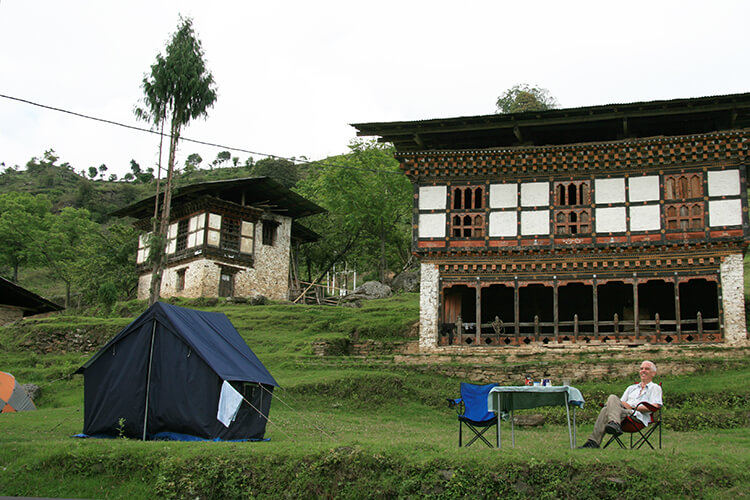
Congratulations for getting through How Much Do Treks Cost!
Now it’s time to have a think about what sort of impact you are likely to have on your trek. It’s not just about money, you can help create positive impacts, or make things worse for the locals… time for The Impact of Your Trek.